
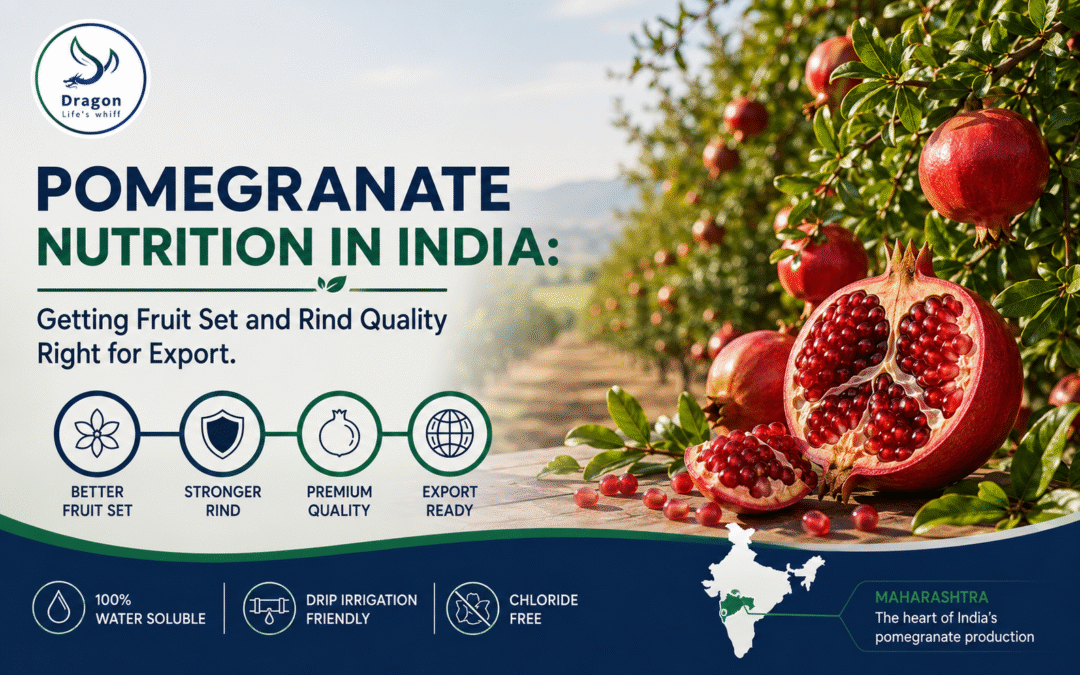
India grows more pomegranates than any other country, close to half the world’s supply, and Maharashtra alone accounts for the bulk of it. Most of that fruit is sold at home, but the export share going to the Gulf, Europe, and increasingly North America is where the money is. And export buyers are fussy about two things a grower controls through nutrition: whether the fruit sets properly in the first place, and whether the rind arrives clean and unblemished.
Get those two right and a crop moves from juice-grade to export-grade. This piece looks at how nutrition drives both, and where Dragon Ferti’s water-soluble range fits an Indian pomegranate program run under drip.
The bahar system changes how you feed
Indian pomegranate does not follow one flowering cycle a year. Growers pick a bahar, a flowering season, and manipulate the tree into it through a stress-and-recovery routine: withhold water, drop the leaves, then feed and irrigate hard to trigger bloom. Mrig bahar (June flowering), ambe bahar (spring), and hasta bahar (autumn) each suit different regions and market windows.
What matters for nutrition is that the tree gets pushed from near-dormancy into heavy flowering on a schedule the grower sets. That recovery feed after bahar treatment is the moment that shapes the whole year. The tree needs phosphorus and a root trigger to wake up, then a rapid shift toward the calcium and boron that decide fruit set.
Fruit set and cracking: a calcium and boron story
Poor flower set and fruit drop are the most common complaints in Indian pomegranate, and both trace back to weak calcium and boron during flowering. The same two nutrients also govern rind strength later, which is what stops fruit from cracking in the field and bruising in transit.
Here is how the priorities shift across the cycle:
| Stage | What the tree needs | Dragon Ferti fit |
|---|---|---|
| Post-bahar recovery | Phosphorus, root activation | Dragon Rooty, Dragon Fert High Phosphorus |
| Flowering and set | Boron, calcium | Dragon BorCal |
| Fruit development | Balanced feeding, magnesium | Dragon Fert Balanced, Dragon MagiCal |
| Fruit fill and colour | Potassium, sustained calcium | Dragon Fert High Potassium, Dragon PureCal |
The through-line is calcium. A pomegranate that loads calcium into its rind during development holds together through picking, grading, and the three-week sea journey to a European or Gulf retailer. A calcium-short fruit cracks on the tree or arrives soft.
Why soluble matters more here than elsewhere
Maharashtra runs more land under drip than any other Indian state, and pomegranate is one of the crops driving that. Once a grower is fertigating, the fertilizer has to be fully water-soluble or it clogs emitters and distributes unevenly. This is exactly what the Dragon Fert soluble powder line is built for: it dissolves completely, carries no chloride, and runs clean through drip.
Chloride deserves a special mention. Pomegranate takes up chloride readily, and many cheap potassium fertilizers are potassium chloride. Over a few seasons that chloride shows as leaf-tip scorch and duller fruit. Dragon Ferti products are chloride-free across every line, which protects both the tree and the rind finish that export markets grade on. If you want to check any product for this yourself, the guide to reading a fertilizer label walks through where to look.
Micronutrients on semi-arid soils
Pomegranate grows on the sandy loam and semi-arid soils of Maharashtra, Gujarat, and Rajasthan, where zinc and iron often run short. A couple of foliar corrections a year, timed to the flush after bahar and again during early fruit growth, keep the canopy productive. Dragon Mix Plus covers the full micronutrient set in one spray.
Conclusion
Indian pomegranate rewards precision. The bahar system hands growers control over when the tree flowers, and a nutrition program built around phosphorus at recovery, boron and calcium at set, and potassium with steady calcium through fill turns that control into export-grade fruit. Dragon Ferti’s soluble and specialty lines give a distributor a clean, chloride-free toolkit for the whole cycle. Browse the full product range or reach the team through the contact page to build a program for Indian pomegranate growers.
Frequently asked questions
What causes poor fruit set in pomegranate?
Weak calcium and boron nutrition during flowering is the most common cause. Both nutrients are essential for pollen viability and for the fruit to hold rather than drop. A boron and calcium product like Dragon BorCal applied at flowering and early set addresses it directly, alongside good water management through the bahar recovery.
How do I stop pomegranate fruit from cracking?
Cracking is largely a calcium and rind-strength issue, made worse by uneven watering. Load calcium into the fruit steadily through development using a soluble calcium product like Dragon PureCal, and keep irrigation consistent so the fruit does not take up water in sudden surges. Strong rind resists both field cracking and transit bruising.
Why use water-soluble fertilizer for pomegranate instead of granular?
Most Indian pomegranate is grown under drip irrigation, and only fully soluble fertilizer runs cleanly through a drip system without clogging emitters or distributing unevenly. Soluble feeding also lets you match nutrients to each bahar stage precisely. The Dragon Fert soluble powder line is chloride-free and dissolves completely for this purpose.
Which nutrients matter most for export-grade pomegranate?
Calcium and boron for fruit set and rind strength, potassium for size and colour, and phosphorus at the post-bahar recovery stage. Chloride-free inputs matter throughout, since chloride buildup dulls fruit and scorches leaves over time, which export buyers notice.