
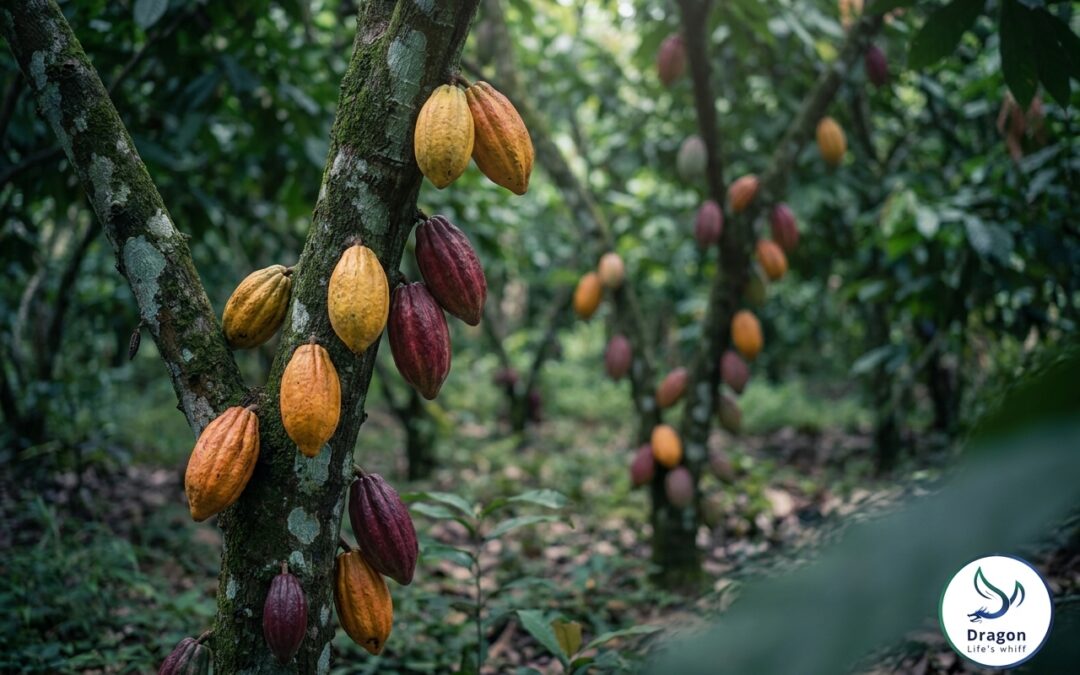
Nigeria is the world’s fourth-largest cocoa producer. It used to be the second-largest. The slip down the rankings wasn’t because Nigerian farmers stopped growing cocoa – it was because yields per hectare stayed flat for thirty years while Côte d’Ivoire and Ghana invested in inputs, agronomy, and replanting.
The average Nigerian cocoa farm produces around 400 kilograms per hectare. The agronomic ceiling, with proper nutrition and tree management, is somewhere between 1,500 and 2,000 kilograms. That gap – roughly 4x current yield – is the single biggest opportunity in Nigerian agriculture, and most of it is downstream of fertilization.
This article covers what a serious nutrition program looks like for Nigerian cocoa, why specialty fertilizers fit smallholder economics better than people assume, and how Dragon’s paste, soluble powder, and micronutrient lines apply across the Ondo, Cross River, Osun, and Ekiti production zones.
The yield gap, and why it persists
Cocoa is grown on roughly 1.4 million hectares in Nigeria, mostly by smallholders with farms of 1 to 5 hectares. The yield gap isn’t a mystery – it’s a combination of:
| Factor | Current state in most Nigerian cocoa farms |
|---|---|
| Tree age | Often 30+ years; productive life of cocoa is 25–30 years |
| Fertilization | 0 – 50% of recommended NPK rates; many farms apply nothing |
| Soil acidity | pH 4.5 – 5.5; high Al/Fe content drives severe P fixation |
| Micronutrients | Zinc, boron, copper deficiencies widespread but rarely tested |
| Disease pressure | Black pod (Phytophthora) and capsids; both worsen with nutrient stress |
Variety and climate aren’t the bottleneck. Yield-doubling on Nigerian cocoa starts with consistent NPK plus targeted micronutrient correction, then layers in tree renewal and disease management. Fertilization alone, well-executed, will usually move a farm from 400 to 700-900 kg/ha within two seasons.
Cocoa’s specific nutritional demands
Cocoa is a heavy nutrient remover. A well-managed orchard producing 1,500 kg of dried beans removes roughly 30 kg of N, 6 kg of P₂O₅, 50 kg of K₂O, plus meaningful amounts of magnesium and calcium per hectare per year. Replacing those numbers is non-negotiable for sustained yield.
What makes Nigerian cocoa different from MENA tree crops:
- Acidic soils, not alkaline. Most Nigerian cocoa grows on pH 4.5–5.5 soils. Iron isn’t usually limiting (it’s abundant at low pH). The limitations are P-fixation (locked up by Al and Fe in acidic clay), and severe deficiencies in zinc, boron, and copper.
- High rainfall leaches K and Mg. The cocoa belt receives 1,200–1,800 mm of rain annually, most of it in the wet season. Potassium and magnesium leach from the topsoil rapidly. K replenishment has to be split across multiple applications, not delivered in a single dose.
- Boron drives pod set. Cocoa flowers prolifically – a productive tree produces 10,000+ flowers per year – but most don’t develop into pods. The early-stage wilt of small developing pods, called cherelle wilt, has multiple causes, but boron and calcium nutrition are central to reducing it.
Micronutrient deficiencies you can usually see
Tissue testing is rare on Nigerian smallholder cocoa, but visual diagnosis catches most of the major deficiencies:
- Zinc deficiency: small, narrow, often distorted leaves at branch tips; pale yellowish-green color; the “sickle leaf” symptom. Most common limitation on Nigerian cocoa soils.
- Boron deficiency: thick, brittle, often deformed young leaves; corky stem lesions; severe cherelle wilt; small misshapen pods. Visible in older trees on long-cultivated soils.
- Copper deficiency: wilting young leaves despite adequate water; reduced flowering; weak terminal growth. Less common but underdiagnosed.
- Manganese deficiency: interveinal yellowing of middle-aged leaves while youngest growth stays green; usually appears on lighter sandy zones.
A single application of Dragon Mix Plus covers all four elements in one foliar spray.
For targeted corrections, Dragon Zinc 13%, Dragon BorCal, and Dragon Copper 12% are the workhorses. Most Nigerian cocoa farms benefit from a multi-element foliar twice per year minimum – once at flowering onset, once during pod fill.
Building an NPK program
The base NPK program for Nigerian cocoa should run on two principles: split applications across the rainy season, and adjust ratios across the year.
- Pre-flowering (Sep – Oct): Dragon Paste Balanced at moderate rate, plus Dragon Mix Plus foliar – loads micros into developing buds.
- Flowering (Nov – Dec): Dragon Paste High-PK plus Dragon BorCal foliar – supports pollen viability and pod set.
- Pod fill (Jan – Apr): Dragon Paste High Potassium or Dragon PotaMax – the heaviest K demand window.
- Post-harvest (May – Aug): Dragon Sea or Dragon PK Humic – soil biology and reserve restoration through the wet season.
For acidic-soil P fixation specifically, Dragon PK Humic is worth highlighting. The humic acid complexes hold phosphorus in plant-available form, getting around the Al/Fe lockup that wastes most conventional P applications on Nigerian cocoa soils. It’s not a replacement for liming on severely acidic soils – pH below 4.5 needs agricultural lime – but it dramatically improves P efficiency in the pH 5.0–5.5 range typical of most cocoa belts.
The smallholder economics question
A common objection: “specialty fertilizers are for export farms, not smallholder cocoa.” It’s not quite right. The economics work for cocoa cooperatives and aggregator-supplied farms specifically because cocoa price per kilogram is high relative to fertilizer cost per kilogram. A 500 kg/ha yield improvement at $2.50/kg cocoa is $1,250/ha in additional revenue – easily covering a $200–400/ha specialty fertilizer upgrade.
The structural barrier isn’t economics. It’s distribution. Smallholder farmers buy fertilizer in small bags from local retailers – they can’t import directly. The opportunity for Dragon in Nigeria sits with cocoa cooperatives, aggregators, the Cocoa Association of Nigeria (CAN), and agricultural input distributors who can serve the smallholder market with branded specialty products.
The specialty fertilizer ROI economics hold for cocoa even at smallholder scale, given the right distribution model. For distributors and cooperatives interested in supplying Nigerian cocoa farmers with Dragon products – and for the foliar program details most cocoa operations need – the contact page is the starting point. Dragon ships to West Africa through Lagos and Port Harcourt.
Frequently asked questions
Why are average Nigerian cocoa yields so much lower than potential?
Three reasons in roughly equal weight: aged trees (most Nigerian cocoa is past peak productive age), chronic under-fertilization (most farms apply 0-50% of recommended rates), and untreated micronutrient deficiencies (especially zinc and boron). A farm that addresses fertilization and micros alone, without replanting, typically moves from 400 to 700-900 kg/ha within two seasons.
What micronutrients are most often deficient in Nigerian cocoa soils?
Zinc is the most widespread limitation, followed by boron, then copper. Manganese deficiency shows up on lighter sandy soils. Multi-element correction through Dragon Mix Plus (or targeted single-element products from the Dragon Minor Elements range) handles all of these.
Is fertilization economical for smallholder cocoa farmers?
Yes – the math works because cocoa price per kilogram is high. A 500 kg/ha yield improvement at $2.50/kg cocoa is roughly $1,250/ha in additional revenue, against a $200–400/ha specialty fertilizer upgrade. The barrier is usually distribution and access to working capital, not the cost-benefit calculation itself. Cocoa cooperatives and aggregator-financed programs are the most common way smallholders access specialty fertilizers.
What’s the role of boron in cocoa pod set?
Boron is essential for pollen tube growth and fruit set. Cocoa flowers heavily but converts only a small fraction of flowers into mature pods – early-stage cherelle wilt is the main cause of pod loss. Boron deficiency increases cherelle wilt rates and produces small, misshapen pods even from successful sets. A foliar Dragon BorCal application at flowering onset and again during early fruit development reduces both problems.
Does Dragon supply to Nigeria, and through what distribution channels?
Dragon ships to West Africa via Lagos and Port Harcourt ports. The current focus is on building distributor relationships with cocoa cooperatives, agricultural input chains, and the Cocoa Association of Nigeria’s commercial wing. For distributor inquiries, the export team is reachable via the contact page.