
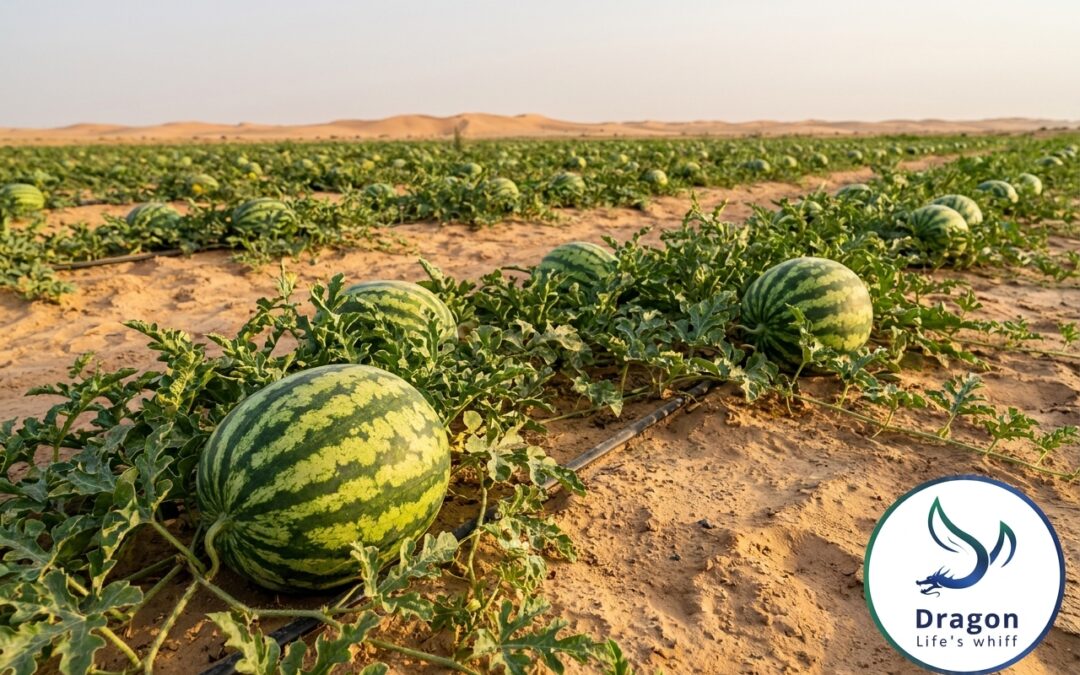
The most useful proof in agronomy is what happens on a real farm. Marketing claims read the same way no matter how they’re written. A documented field trial – same variety, same farmer, same season, with controls – settles the argument.
In Algeria, Dragon Paste 20-10-60+TE was tested on commercial watermelon in El Oued, the country’s largest watermelon-producing region. The trial measured fruit weight, fruit diameter, and overall yield against a conventional NPK program. The Dragon Paste plots outperformed on all three metrics. The field trial writeup is on Dragon’s testimonials page, and it’s worth reading before anything else about Algerian watermelon fertilization.
This article explains why those results happened, and how the same principles work for any commercial watermelon operation in the El Oued, Biskra, M’Sila, or Ouargla wilayas.
What’s different about El Oued
El Oued produces roughly five million tons of watermelon a year – one of the largest concentrations of watermelon production in Africa. The land is desert. The soils are sandy, with very low organic matter (often under 0.5%), high pH (7.8 to 8.3), and low cation exchange capacity. Irrigation comes from deep aquifer wells, often with bicarbonate concentrations above 250 ppm.
That combination breaks most commodity fertilizer programs in three ways:
- Sandy soil leaches nutrients fast. A heavy weekly NPK 15-15-15 application loses most of its nitrogen and potassium to the deep profile within days. Frequent, lighter doses through fertigation are far more efficient.
- Alkaline irrigation water precipitates fertilizers in the lines. Calcium and bicarbonate react to form scale at the drip emitters. By mid-season, half the emitters are partially blocked, and water distribution is uneven across the plot.
- Calcium deficiency causes blossom-end rot and hollow heart – the two main rejection causes for watermelon in any market.
Dragon Paste was engineered for this combination. Its pH 2.5 dissolves bicarbonate scale on injection, keeping irrigation lines clean. Its high-potassium and trace-element formulation delivers what watermelon actually demands at the rates the plant needs. And Dragon’s calcium-supporting specialty products handle the rejection-causing disorders directly.
Watermelon’s nutrient demand curve
Watermelon’s nutritional needs change sharply across the growing cycle. The same NPK applied uniformly across the season wastes product in the wrong stages and underfeeds in the right ones.
| Week | Stage | Nutrient priority |
|---|---|---|
| 1–2 | Transplant establishment | High P, low N, root stimulator |
| 3–5 | Vine extension | High N, moderate K |
| 5–7 | Flowering, fruit set | Balanced PK, calcium + boron critical |
| 7–10 | Fruit expansion | High K, sustained calcium |
| 9–11 | Maturation, sugar accumulation | High K, declining N |
The Dragon Paste line maps directly onto this curve. Dragon Paste High Phosphorus and Dragon Rooty handle the first two weeks. Dragon Paste High Nitrogen drives vine extension. Dragon Paste High-PK plus Dragon BorCal covers flowering and fruit set. And Dragon Paste High Potassium – specifically the 20-10-60+TE formula tested in the El Oued trial – carries fruit expansion and ripening.
Calcium and the rejection problem
Blossom-end rot and hollow heart are the same problem with different names. Both are caused by inadequate calcium reaching the developing fruit during a specific window – usually the first three weeks after fruit set. The cause isn’t always low soil calcium. It’s often a failure of calcium transport to the fruit when water flow through the xylem can’t keep up with demand during a hot stretch.
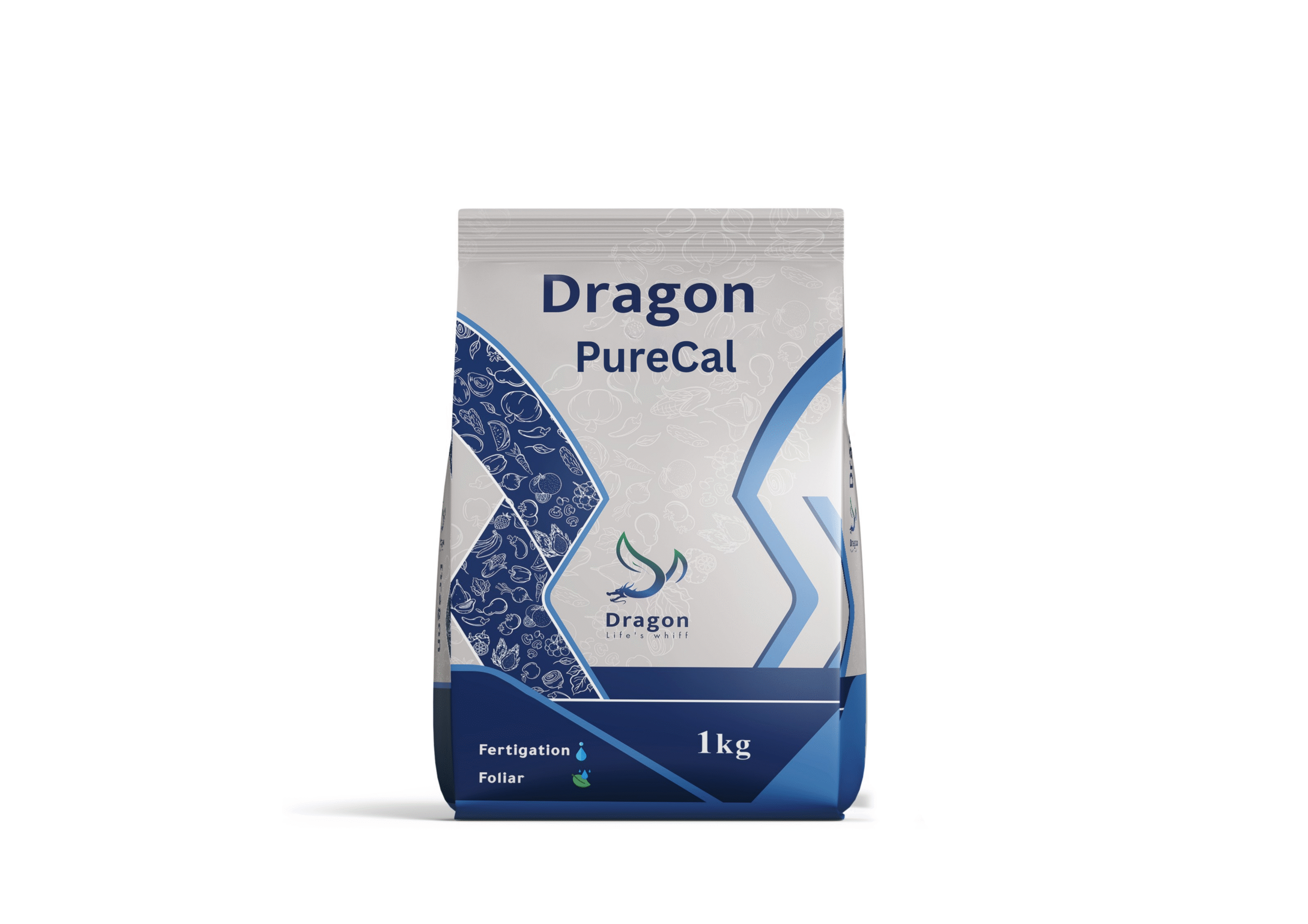
The solution is a sustained calcium program: Dragon PureCal or Dragon Calibo (calcium + boron) applied through drip fertigation, two or three times a week during the critical fruit-set and early-expansion phases. Foliar calcium is a supplement, not a substitute – calcium moves poorly through the leaf, and most of it has to come up through the roots.
For El Oued operations specifically, where temperatures regularly exceed 40°C during fruit fill, the calcium program also reduces sun-scald and improves shelf life. Algerian watermelon increasingly travels to France, Italy, Senegal, and the Gulf, and fruit firmness on arrival is what determines whether the shipment grades up.
Why specialty wins on sandy desert soils
The economic argument for water-soluble specialty fertilizer in El Oued comes down to one number: nutrient use efficiency. Commodity NPK broadcast on sandy soil delivers maybe 30% of its nitrogen and potassium to the plant. The rest leaches to the deep profile within two weeks. Drip-fertigated Dragon Paste delivers 70-80% of applied nutrients to the root zone because the application matches the plant’s uptake rate and the sandy soil’s holding capacity.
That’s not theoretical. The El Oued field trial showed measurable yield, fruit weight, and fruit diameter improvements using the same total fertilizer budget – Dragon Paste simply delivered more of what it applied. The Algeria distributor partnership has expanded based on this kind of result, with new wilayas adding Dragon products each season.
The foliar fertilization guide covers the spray side of the program in detail, and the specialty fertilizer ROI breakdown walks through the economics. For Algerian farms running the 20-10-60+TE program on watermelon, or evaluating other specialty fertilizers for melon, tomato, or pepper crops, the contact page is the way in.
Frequently asked questions
What were the results of Dragon’s Algerian watermelon trial?
The trial documented measurable improvements in fruit weight, fruit diameter, and overall harvest yield using Dragon Paste 20-10-60+TE compared to a conventional NPK control. The full writeup is on the Dragon testimonials page. The trial was conducted on commercial watermelon in El Oued, in cooperation with Dragon’s local distributor partner.
Why use water-soluble paste fertilizer in desert watermelon production instead of granular?
Sandy desert soils have low cation exchange capacity, which means granular fertilizers leach nutrients to the deep profile within days. Water-soluble paste delivered through drip fertigation matches the application rate to the plant’s actual uptake rate. Efficiency goes from around 30% with broadcast granular to 70-80% with fertigated soluble. On the same fertilizer budget, more of what you apply reaches the plant.
How do I prevent blossom-end rot and hollow heart in El Oued watermelon?
A sustained calcium program during fruit set and early expansion. Apply Dragon PureCal or Dragon Calibo through drip fertigation two to three times per week from fruit set through the third week of fruit expansion. Don’t rely on a single foliar application – calcium has to come up through the roots in continuous supply, and the daily heat in El Oued accelerates demand.
Can I use Dragon Paste in saline well water typical of southern Algeria?
Dragon Paste is free of chloride and sodium, so it doesn’t add to existing salinity. The pH 2.5 formulation also helps with the bicarbonate scale common in deep-aquifer water. For wells above 2,000 µS/cm EC, run a soil and water analysis first – the fertilizer choice doesn’t change, but you may need to manage irrigation differently to keep root-zone salinity in check.
What’s Dragon’s distribution presence in Algeria?
Dragon has an established distributor partnership in Algeria covering the major watermelon-producing wilayas. The Rooted in Jordan, Growing in Algeria news piece covers the partnership in detail. New regional distributors are added each season – for distributor inquiries, contact the export team via the contact page.